Orthopaedics
Understanding shoulder OCD
Osteochondritis dissecans, often shortened to OCD, is a joint condition that mainly affects young dogs. It can cause front-leg lameness, sometimes subtle at first, which deserves a veterinary examination when it persists or comes back.
A cartilage abnormality during growth
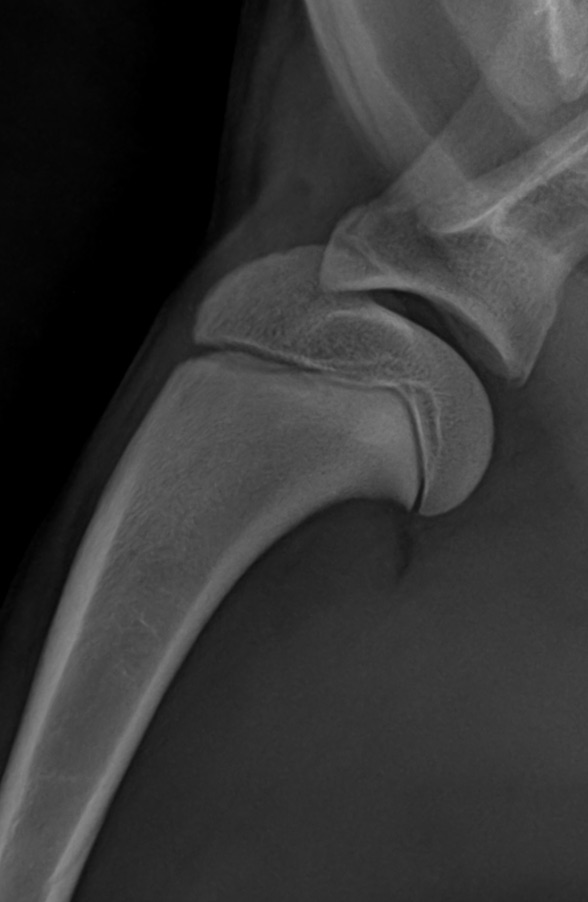
As a dog grows, the growth cartilage at the ends of the bones is gradually turned into bone. In osteochondrosis, this process goes wrong at one specific spot. The cartilage thickens and may crack. When a flap of cartilage partly or fully separates and communicates with the joint, it is called osteochondritis dissecans.
The flap may stay attached, come loose and sometimes become a free fragment inside the joint. The irritation it causes can lead to pain, joint inflammation and, over time, osteoarthritis. In dogs, the shoulder is a common site, usually on the head of the humerus.[1]
Signs to watch for
Signs often appear in young, growing dogs. You may notice:
- lameness in a front leg;
- lameness that is more obvious after exercise and improves with rest;
- pain or reduced movement in the shoulder.
The lameness may seem to affect only one leg even when both shoulders are involved. This is why the vet may recommend examining and imaging both sides.
These signs alone do not confirm OCD: other orthopaedic problems, such as elbow dysplasia, can cause similar lameness.[1]
When to see a vet
Persistent lameness in a young dog, especially in a front leg, warrants a veterinary examination. Book an appointment if the lameness lasts, returns after exercise or comes back after a period of improvement.
If the lameness comes and goes, a short video of your dog walking can help the vet during the consultation.
How is it diagnosed?
The vet starts by watching the dog walk and examining its joints, then carries out an orthopaedic examination. X-rays of the shoulders can show an abnormality of the surface of the humeral head. Depending on the images and the case, a further test — CT, MRI or arthroscopy — may help to define the lesion.
In a study comparing several imaging techniques with arthroscopy, both MRI and X-rays detected many of the shoulder lesions. The choice of test still depends on the dog, the images already available and the clinical question to be answered.[2]
Treatment depends on the lesion
The approach depends in particular on the size and location of the lesion, how much discomfort the dog has and the condition of the joint. In some cases, the vet may consider medical management and adjusted activity. If the lameness persists or recurs, surgery may be offered.
Surgery involves removing the diseased cartilage flap and treating the edges of the lesion. It can be done by arthroscopy, which allows the joint to be examined and treated with a camera and instruments passed through small incisions, or through a conventional open approach.[1]
A study of 126 dogs treated by arthroscopy reported complete resolution of lameness in 137 of the 150 shoulders operated on, within 7 to 60 days. This result describes that case series; it cannot predict with certainty how each individual dog will do.[3]
Follow-up still matters
After treatment, activity must be resumed gradually, following the vet's instructions. Osteoarthritis may progress in the joint over time.
In a small long-term follow-up study after surgery, owners nevertheless rated their dog's mobility as satisfactory, despite signs of joint changes seen on examination.[4]
Key points
Shoulder OCD is a cartilage abnormality that develops during growth. An accurate diagnosis makes it possible to choose the right treatment and to explain to the owner both the expected benefits and the limits of treatment.
Care at Colvet
If your dog is limping or shoulder OCD is suspected, your regular vet can examine your dog and refer you for an orthopaedic work-up if needed. Colvet also sees referred dogs for veterinary orthopaedic examinations and opinions, in Luxembourg.
Scientific sources
This article is based on the following veterinary publications:
- American College of Veterinary Surgeons (ACVS). Osteochondrosis of the Shoulder. Mechanism, clinical signs, diagnosis and treatment. acvs.org/small-animal/osteochondrosis-of-the-shoulder
- Wall CR, Cook CR, Cook JL. Diagnostic sensitivity of radiography, ultrasonography, and magnetic resonance imaging for detecting shoulder osteochondrosis/osteochondritis dissecans in dogs. Veterinary Radiology & Ultrasound. 2015. pubmed.ncbi.nlm.nih.gov/24844132
- Olivieri M et al. Arthroscopic treatment of osteochondritis dissecans of the shoulder in 126 dogs. Veterinary and Comparative Orthopaedics and Traumatology. 2007. pubmed.ncbi.nlm.nih.gov/17364099
- Zann GJ et al. Long-term outcome of dogs treated by surgical debridement of proximal humeral osteochondrosis. Veterinary Surgery. 2023. doi.org/10.1111/vsu.13866