Fracture in dogs and cats : diagnosis, surgery and recovery
A fracture can happen after a fall, a road accident, a bite, or a seemingly minor knock. Some fractures can be splinted, while others need to be surgically stabilised.
The animal usually shows significant pain and refuses to use the affected leg. Not every fracture requires the same management : some can be splinted, while others need to be surgically stabilised.
How to recognise a fracture in a dog or cat
A fracture is not always visible from the outside. After a trauma, several signs can still raise the alarm :
complete loss of weight-bearing;
sudden, severe lameness;
marked pain when the animal moves;
swelling of the leg;
an abnormal position or angle of the paw;
unusual mobility.
A deformed leg should never be handled in an attempt to put it back in place : these manipulations are extremely painful and can worsen damage to the muscles, nerves or blood vessels surrounding the bone.
Conversely, the absence of a visible deformity does not rule out a fracture. Some incomplete or minimally displaced fractures cause only lameness and localised pain.
What to do immediately after the trauma
The first step is to limit the animal's movements as much as possible. It is recommended to :
keep the animal calm;
avoid handling or straightening the leg;
not make an improvised splint;
never push a bone fragment back under the skin;
never give any painkiller intended for humans;
contact a veterinarian or emergency service quickly.
Is the fracture always the priority?
After a serious fall or road accident, the fracture is often the most visible injury. It is not, however, always the most urgent one. A trauma severe enough to break a bone can also cause chest, abdominal or neurological injuries. The veterinarian therefore starts by checking the animal's overall condition, breathing, circulation and level of pain.
Once the animal is stable, the affected leg can then be examined and temporarily immobilised. Fracture surgery can sometimes be delayed by a few days in order to treat another injury first, or to properly stabilise the patient before anaesthesia.
How is the diagnosis made?
The diagnosis relies on the clinical examination and on X-rays. The examination helps assess the location of the pain, the extent of swelling, the condition of the skin and surrounding tissue, blood flow to the end of the limb, sensation and nerve function, as well as the presence of other injuries.
X-rays confirm the fracture and help clarify its configuration : which bone is affected, the number of fragments, their displacement, and any involvement of a joint or growth plate in a young animal.
Several views are needed to understand the fracture from different angles. Sedation or brief anaesthesia is often preferable : it avoids painful manipulation and produces images precise enough to plan treatment.
Is a cast or splint enough to treat a fracture?
Contrary to a common belief, most fractures cannot be properly stabilised with a simple splint. A rigid cast must absolutely be avoided, as it can cause further tissue damage.
If the fractured animal is under a year old, a bandage with or without a splint may suit certain minimally displaced, relatively stable fractures located low on a limb. To be effective, the immobilisation must block the joints above and below the fracture : this becomes difficult, if not impossible, when a bone such as the femur or humerus is involved. The bandage must also be changed every 7 to 10 days.
With a support bandage, new complications can appear : non-healing due to lack of stability, skin lesions from pressure necrosis and rubbing, irritation or infection linked to moisture, and joint stiffness or muscle wasting with prolonged immobilisation. The choice of conservative treatment therefore depends above all on the stability of the fracture, and requires much more frequent veterinary check-ups.
When is surgery necessary?
Although a few exceptions exist, surgical stabilisation is very often required after a fracture. The goal is to restore the length and alignment of the limb, then to keep the fragments stable enough for the bone to heal.
Surgery offers significant advantages : pain resolves within days to weeks, recovery is faster, fewer follow-up visits are needed, and there are fewer complications than with a bandage.
What does osteosynthesis involve?
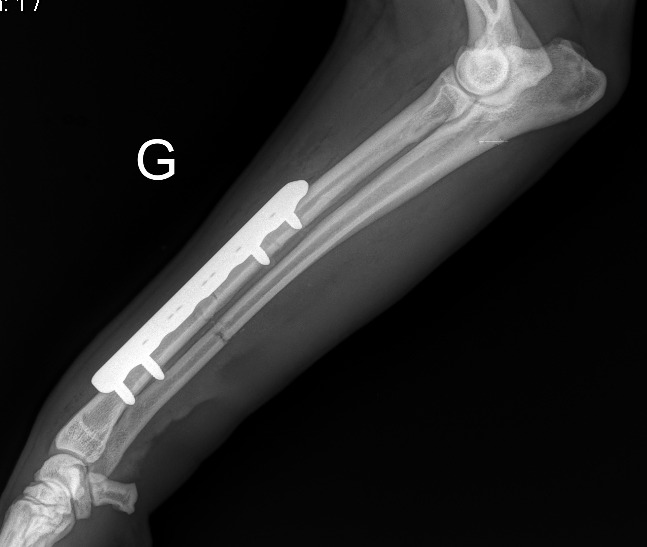
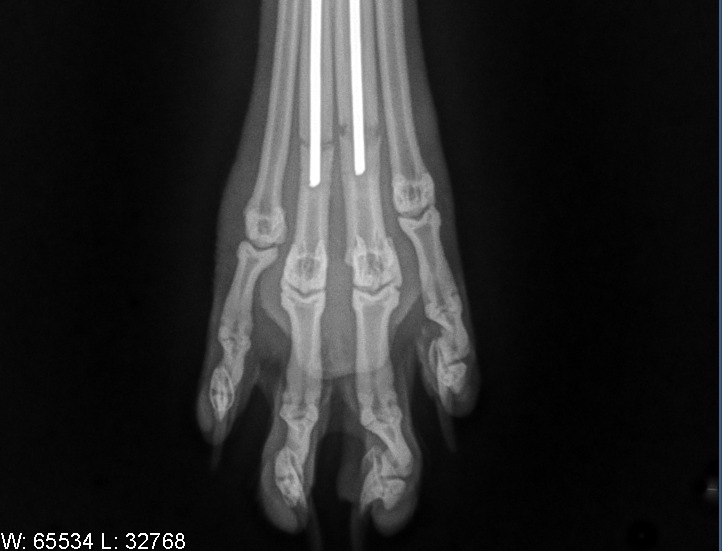
Osteosynthesis refers to the surgical stabilisation of a fracture using implants. Depending on the fracture's configuration, the veterinarian may use a plate fixed to the bone with screws, screws alone to compress certain fragments, pins placed inside the bone's canal, wires combined with other implants, or an external fixator connected to pins passing through the bone. The choice depends on the bone involved, the direction of the fracture line, the number of fragments, the size and age of the animal, the condition of the surrounding tissue, and the stresses the limb will be under.
Radius/ulna fracture stabilised with a bone plate.
Fracture stabilised with intramedullary pins.
In some situations, it is not desirable to individually reposition every small fragment. The priority is then to restore the bone's length and alignment while preserving as much as possible of the tissue and blood supply needed for healing. See more detail on our surgical management of fractures on our fracture and traumatic dislocation surgery page.
What role does fluoroscopy play?
Fluoroscopy provides real-time X-ray images during surgery. It helps check the position of fragments and implants without needing to widely expose the fracture. Depending on the type of injury, this technique allows stabilisation through smaller incisions and better preserves the tissue surrounding the bone, reducing pain and healing time.
Not every fracture can be operated on this way, however. The technique used is chosen individually after reviewing the X-rays. Our surgical suite is equipped to offer this approach when it is suitable.
What does recovery involve?
After surgery, the animal receives appropriate pain management. The wound, weight-bearing and overall condition need to be monitored during the first few days. Even though the surgical construct stabilises the fracture, the bone is not immediately healed : a period of strict rest remains essential. During this phase :
dogs should only go outside for short, leashed walks;
running, playing and jumping must be prevented;
cats should stay indoors, in a confined space;
the wound must be protected from licking;
medication must be given as prescribed;
any increase in pain or swelling should be reported.
Some animals start bearing weight again quickly. This improvement does not mean the fracture has healed : excessive activity can displace the fragments, loosen the screws, or break the implants. This recovery phase generally lasts 6 to 8 weeks.
Why are follow-up X-rays essential?
The resumption of activity should not be decided based on how the animal is walking alone. Follow-up X-rays are taken after several weeks to assess bone formation and the stability of the construct. The timing depends on the animal's age, the bone involved and the type of fracture : a check-up around six weeks is often proposed, but it may be brought forward or delayed depending on the situation.
Only once sufficient healing is confirmed can walks and activity be increased gradually.
Do the implants need to be removed?
Plates, screws or pins do not systematically need to be removed once the fracture has healed. When implants are well tolerated, they can generally stay in place. Removal may nonetheless be recommended if they cause discomfort, if they shift, if they are associated with infection, or in certain specific situations in a growing animal. The decision is based on the clinical examination and X-rays. We cover these situations in our article on whether plates and screws should be removed after a fracture.
What outcome can be expected?
Many fractures in dogs and cats heal well when properly stabilised and when rest instructions are followed. The outcome nonetheless depends on :
the location and complexity of the fracture;
whether a joint is involved;
the condition of the muscles, nerves and blood vessels;
whether the fracture is open or closed;
the animal's age and general condition;
how well rest and post-operative check-ups are followed.
Early management helps limit pain, avoid healing in a poor position, and increase the chances of regaining satisfactory function of the limb.
Fracture care at Colvet
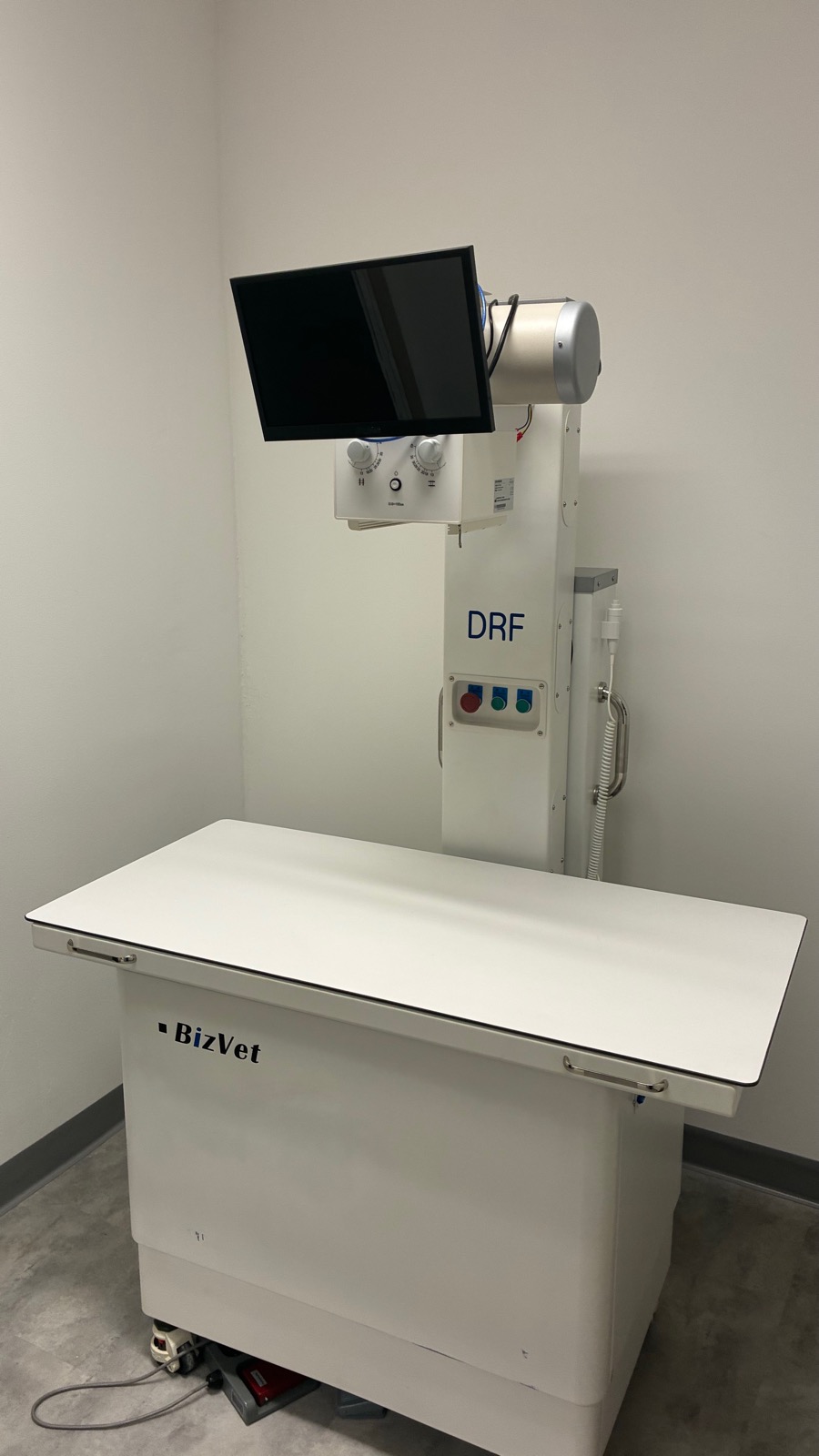
At Colvet, care begins with a full assessment of the animal and the affected leg. X-rays are then taken to precisely understand the fracture and plan treatment.
When surgery is indicated, the construct is chosen individually based on the fracture and the animal's build. Our digital X-ray equipment, fluoroscope and range of osteosynthesis systems allow us to adapt the technique to each patient.
After surgery, we follow up on the wound, functional recovery and radiographic healing through to the gradual resumption of activity.
General information article. It does not replace a consultation: only a veterinary examination can establish a diagnosis and offer the treatment suited to your animal.
Has your dog or cat just had a trauma?
Loss of weight-bearing or a deformed limb needs prompt attention
Outside opening hours, please contact your nearest veterinary emergency service.