My dog or cat may have a fracture: what should I do?
A fall, a road accident, a blow or a badly landed jump can cause a fracture. Call your vet straight away, limit movement, don't improvise: the right reflexes while you wait for the appointment.
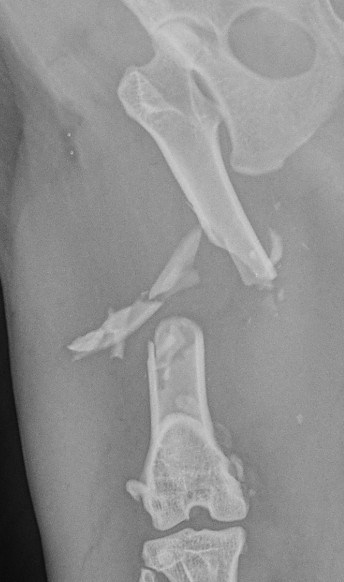
Femoral fracture with several fragments after trauma.
Orthopaedic emergency
The right reflexes when a fracture is suspected
A fall, a road accident, a blow or a badly landed jump can cause a fracture in a dog or a cat. When an animal suddenly goes lame, refuses to put a leg down or is in obvious pain, it is essential to react correctly.
The first reflex should always be to contact your regular vet immediately. A suspected fracture needs a prompt veterinary assessment. Until the appointment, a few precautions help limit pain and the risk of making the injuries worse.[1, 2]
How can you recognise a possible fracture?
A fracture is a partial or complete break in a bone. Contrary to what you might think, it is not always visible from the outside.
Several signs can point to a fracture:
sudden, severe lameness;
refusal to put a leg on the ground;
marked pain when the leg is moved or touched;
swelling appearing after trauma;
a deformed limb or a limb held in an abnormal position;
a deep wound, sometimes with a visible bone fragment;
difficulty getting up or moving after a fall or an accident.
Be careful: an animal that can still walk may well have a fracture. Depending on its location and severity, a fracture can remain partly stable and still allow some weight-bearing.[2]
Conversely, severe lameness can also be caused by a dislocation or a ligament injury. A veterinary examination, usually followed by X-rays, is needed to identify the injury precisely.
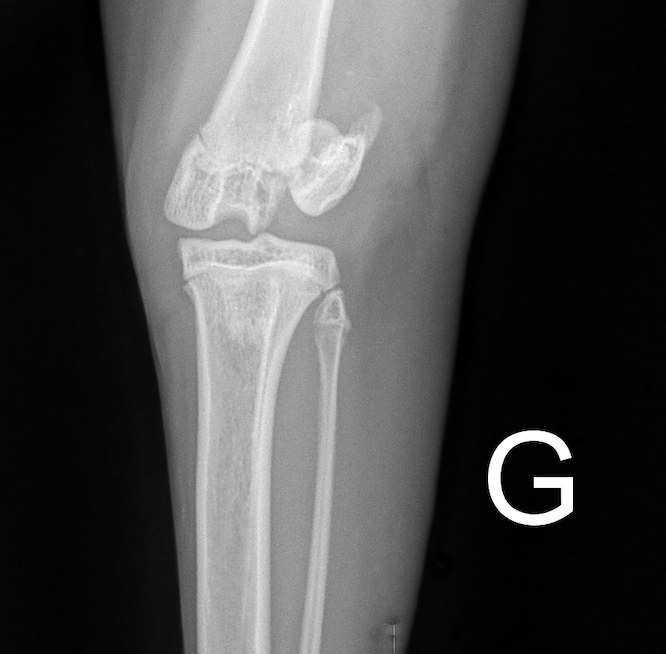
Fracture of the lower end of the femur, through the growth plate, in a young animal (front view, “G” = left limb). This type of fracture cannot be seen from the outside: only an X-ray can identify it. Click to enlarge.
First reflex: call your regular vet
If you suspect a fracture, contact your regular vet immediately. Don't wait until the next day to see whether your animal improves.
Your vet can assess the situation, give you advice on transport and arrange an appointment as quickly as possible.
When you call, try to describe how the accident happened, when it happened, whether your animal can move and whether there are any wounds or bleeding.
Your regular vet is the first point of contact to:
assess your animal's general condition and the severity of the trauma;
look for any associated injuries;
give appropriate pain relief;
carry out the first diagnostic tests;
arrange specialised orthopaedic care if needed.
This first assessment is particularly important after a road accident or a significant fall. A fracture can be accompanied by chest, abdominal or neurological injuries that are not immediately visible.[3, 4]
Breathing difficulties, loss of consciousness, heavy bleeding, very pale gums or extreme weakness are signs of a life-threatening emergency. Immediate care in an emergency veterinary facility is essential.
The sooner a fracture is treated, the better your animal's chances of recovery generally are.
An early consultation first of all relieves pain quickly, which can be particularly intense with a fracture. It also allows the injured limb to be properly immobilised and prevents movement from making the injuries worse.
The time to treatment can also influence the long-term outcome. Over time, the tissues around the fracture change and the bone fragments can become harder to reposition correctly. In some situations, particularly when the fracture involves a joint, delayed treatment can increase the risk of complications and lasting functional problems.[2, 6]
A study published in 2026 in the scientific journal Veterinary Surgery, covering 211 humeral condylar fractures in dogs, showed that a longer delay before surgery was associated with less accurate reduction of the bone fragments. This poorer reduction was in turn associated with more complications and poorer short-term functional outcomes.[6]
A fracture treated promptly therefore offers a better chance of returning to normal, comfortable movement. Waiting too long, on the other hand, can make recovery more difficult and, in some cases, lead to persistent or even permanent lameness.
That said, prompt care does not necessarily mean immediate surgery. After major trauma, your vet may first need to stabilise your animal's general condition before surgery can be considered.
The key point is never to leave a suspected fracture for several days without veterinary advice.
What to do while waiting for the appointment
Once you have contacted your vet, the aim is simple: limit your animal's movements so as not to make the injuries worse.
1. Keep your animal from moving around
Above all, do not make your dog or cat walk to check whether it can still use its leg.
Movement can displace the bone fragments and cause further damage to the surrounding muscles, nerves or blood vessels.[2]
Settle your animal in a quiet, confined space. For a cat or a small dog, use a carrier. For a large dog, restrict its movements as much as possible until it can be transported.
2. Don't handle the injured leg
Even if the limb looks deformed, never try to straighten it or put a bone back in place.
Don't test how the leg moves or try to find the fracture yourself either. Such handling may worsen the injury and cause additional pain.
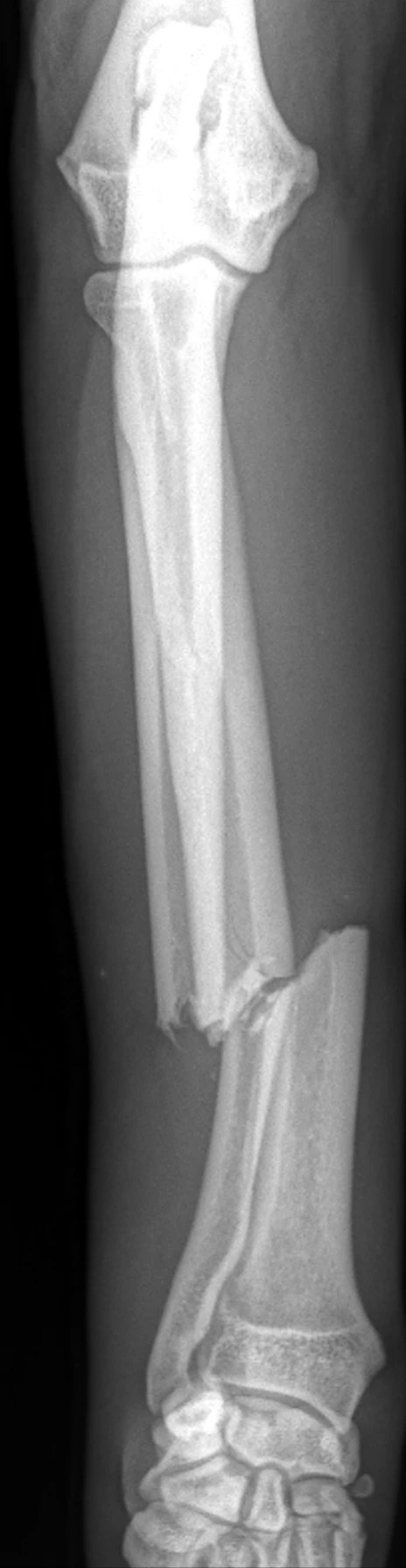
Displaced fracture of the radius and ulna (forearm). The irregular, sharp bone ends show why you should never try to straighten a deformed leg. Click to view the full X-ray.
3. Don't improvise a cast or a splint
A splint can be useful to temporarily stabilise some fractures, but applying one requires precise knowledge of the area to be immobilised.
Inappropriate immobilisation can create pressure points, disrupt blood flow or fail to stabilise the bone fragments properly.
So don't apply a cast, a splint or a tight bandage without instructions from your vet.[2]
4. What if there is a wound?
If a fracture is accompanied by a wound, especially when a bone fragment is visible, it may be an open fracture.
This type of fracture carries a high risk of infection and requires urgent veterinary care.
Don't try to clean the wound deeply or push a bone fragment back in.
5. Don't give any painkiller without veterinary advice
It can be tempting to give a medicine to relieve your animal. Yet some medicines that are very common in humans are dangerous for dogs and cats.
Ibuprofen in particular can cause serious digestive and kidney damage. Paracetamol (acetaminophen) is especially toxic to cats.[5]
Never give a human medicine, or even leftover veterinary treatment, without first consulting your vet.
How to transport an animal with a possible fracture
Transport should be done carefully, limiting movement of the injured area as much as possible.
Cat or small dog: use a sufficiently large carrier. Ideally, choose one whose top can be removed, so that the animal can be placed inside without too much handling.
Large dog unable to walk: a thick blanket or a rigid board can be used to move it, with the help of a second person if needed.
Suspected spinal injury: keep the head, neck and back aligned as much as possible during the move.[1]
Finally, remember that an animal in pain may react defensively in unusual ways, even towards its owners. Be careful when handling it and don't take unnecessary risks.
What happens next at the vet's?
The vet's priority is to assess the animal's general condition and relieve its pain. After major trauma, the animal sometimes needs to be stabilised before orthopaedic tests can be carried out.
When its condition allows, X-rays are usually taken to confirm the fracture, determine its location and assess any displacement of the bone fragments.
Depending on the circumstances of the accident and the findings of the clinical examination, further tests of the chest, abdomen or other parts of the body may also be indicated.[3, 4]
If the fracture requires specialised care, your vet can refer you to an orthopaedic surgery service.
In conclusion: the right reflexes can make the difference
A suspected fracture should always be taken seriously, even if your animal still seems able to walk.
The first thing to do is to call your regular vet immediately. While waiting for their instructions, limit your animal's movements, avoid handling the injured limb, don't improvise any immobilisation and don't give any medicine.
Remember that a neglected fracture can leave permanent after-effects. Seeking care quickly not only relieves your animal sooner, but also gives it the best chance of regaining normal use of its limb.
Finally, keep in mind that after violent trauma, the most visible injury is not necessarily the most serious. A prompt veterinary assessment makes it possible not only to diagnose a fracture, but also to look for complications that could endanger your animal's life.
Fracture care at Colvet
At Colvet in Luxembourg, we treat fractures in dogs and cats, whether or not they require surgery. We can carry out X-rays promptly and operate when necessary, in our surgical suite.
This care is provided in collaboration with the animal's regular vet. The surgery and the stages of recovery are described in our article Fracture in dogs & cats: surgery and recovery.
Scientific sources
This article is based on the following veterinary publications:
Linklater A, Hanson KR. First Aid and Transport of Small Animals. Merck Veterinary Manual, updated December 2025. First-aid and transport recommendations for injured animals. merckvetmanual.com
American College of Veterinary Surgeons (ACVS). Fractured Limbs. Recommendations on recognising fractures, first aid, immobilisation and treatment. acvs.org/small-animal/fractured-limbs
Linklater A. Trauma in Emergency Medicine in Small Animals. Merck Veterinary Manual, updated March 2026. Trauma assessment and the search for associated injuries. merckvetmanual.com
Roberts VJ, Meeson RL. Feline femoral fracture fixation: what are the options? Journal of Feline Medicine and Surgery. 2022;24(5):442–463. doi.org/10.1177/1098612X221090391
Hovda T. Toxicoses From Human Analgesics in Animals. Merck Veterinary Manual, updated May 2025. Toxicity of human painkillers in companion animals. merckvetmanual.com
Low D, Manou M, Rutherford S. Delays to fracture stabilization and the effect on postoperative outcomes: a retrospective cohort study of 211 canine humeral condylar fractures. Veterinary Surgery. 2026. doi.org/10.1111/vsu.70137
General information article. It does not replace a consultation: only a veterinary examination can establish a diagnosis and propose the right treatment for your animal.