Golden Retriever, 10 years old: a limp that kept coming back
Anti-inflammatories are often very effective at reducing a limp. But when a dog starts limping again as soon as treatment stops, it means the medication was never able to remove the cause of the pain. That is exactly what we saw recently at Colvet.
A limp that kept coming back, even after several weeks of treatment
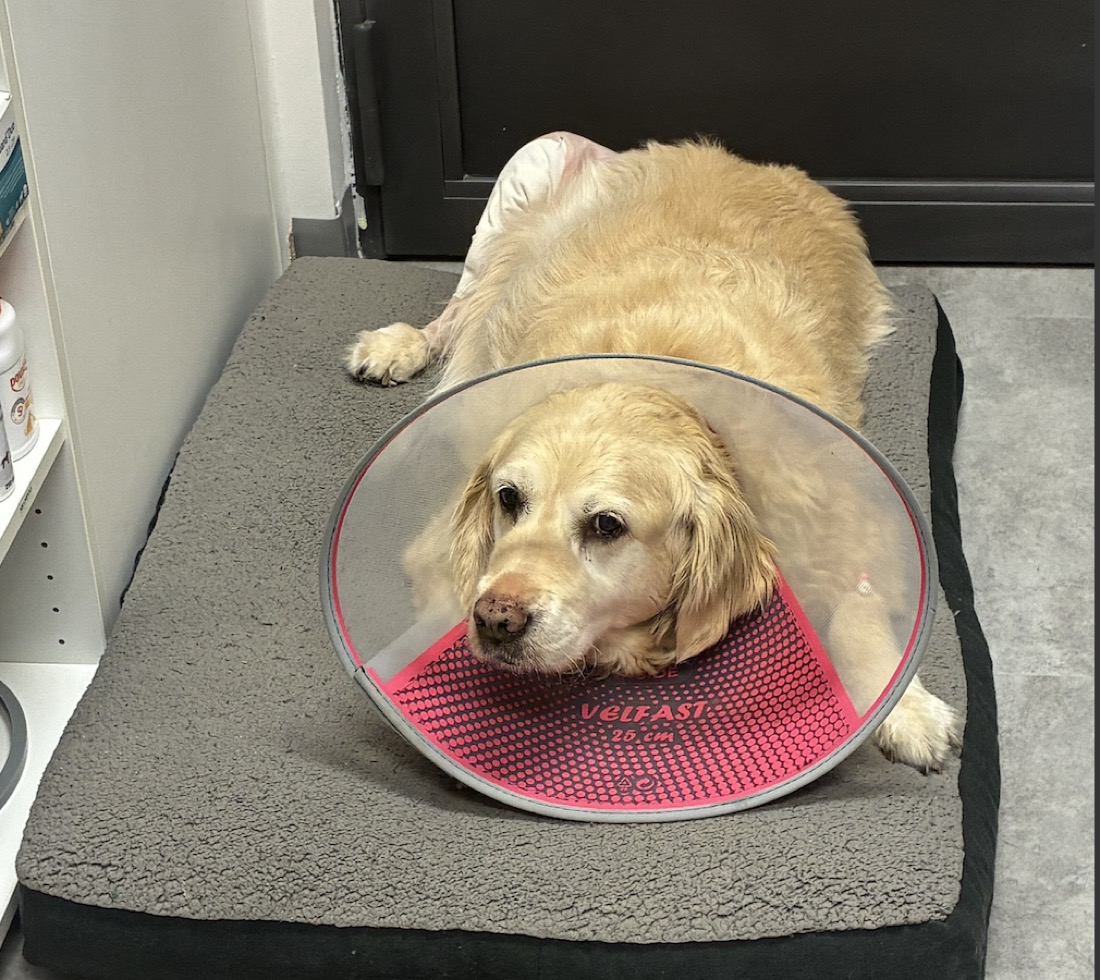
A 10-year-old Golden Retriever, weighing 38 kg, presented with a limp on the left hind limb that had been going on for several weeks.
On several occasions, anti-inflammatory treatment had brought variable improvement. Yet just a few days after the medication was stopped, the limp came back.
This pattern was highly suggestive of a persistent orthopaedic problem.
The orthopaedic examination
After assessing the dog's gait and carrying out a full orthopaedic examination, the source of the pain could be clearly identified.
Although the owner described a limp affecting mainly one leg, several findings on clinical examination raised suspicion of involvement of both knees.
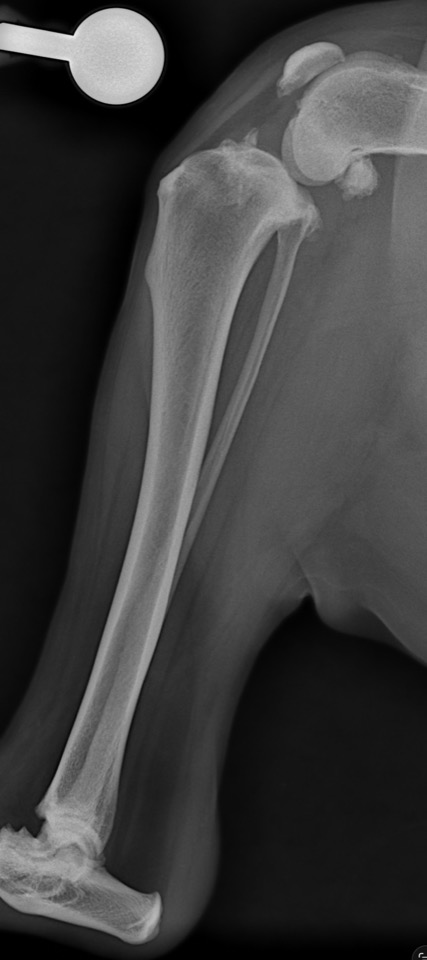
X-rays confirmed this suspicion, showing signs consistent with a chronic rupture of the cranial cruciate ligaments on both sides.
Lateral X-ray of the knee: signs consistent with a chronic cranial cruciate ligament rupture.
Why was the dog only limping on one leg?
This is a question we hear very often.
Contrary to what one might expect, a dog with a bilateral cruciate ligament rupture does not necessarily limp on both legs at the same time.
Most often, one joint is more painful than the other. The dog then shifts its weight onto the less affected leg, giving the impression that the problem is only on one side.
This is precisely why a full orthopaedic examination is essential, even when only one leg appears to be affected.
Anti-inflammatories: useful, but not enough
Anti-inflammatories are effective at reducing pain and inflammation.
However, they do not repair a torn ligament, and can sometimes have devastating side effects.
Once treatment stops, the instability in the knee persists and the pain generally comes back, sometimes very quickly.
Treatment
Once the diagnosis was established, the different treatment options were discussed with the owner.
For cruciate ligament ruptures in dogs of any size, surgical treatment is consistently needed for a good outcome, while limiting the progression of osteoarthritis and improving the animal's comfort. At Colvet, this procedure is called TPLO.
An early diagnosis often saves time
In this particular case, several weeks went by trying different anti-inflammatory treatments. Each one brought temporary relief, but the limp systematically came back as soon as it was stopped.
In the end, the time spent on these successive trials turned out to be almost equivalent to what surgical treatment and its recovery period would have taken. During that time, the ligament kept deteriorating and the osteoarthritis kept progressing.
This is why, when a limp persists or keeps coming back despite well-conducted treatment, it is often more beneficial to look for its cause quickly rather than multiplying symptomatic treatments.
Key takeaway
A limp that systematically comes back after anti-inflammatories are stopped should never be dismissed as simple "overexertion."
It often hides an orthopaedic condition that needs a precise diagnosis.
At Colvet, every persistent limp is investigated with a full orthopaedic examination, to identify the true source of the pain and offer the most suitable solution for each patient.
Clinical case presented for informational purposes. Some details have been simplified and this does not replace a consultation: only a veterinary examination can establish a diagnosis and offer the treatment suited to your animal.
Is your dog limping?
Have the limp examined
No referral from another vet is needed: book an appointment directly for an orthopaedic examination or a second opinion.