Plates, screws and pins : should they be removed after a fracture?
A surgically treated fracture is stabilised with a plate, screws, pins or another fixation system. Once the bone has healed, one question comes up again and again : should this hardware be removed?
In most situations, a well-positioned, stable and well-tolerated internal implant can stay in place. Removal is not routine. It may nevertheless become necessary when the implant causes discomfort, when an infection persists, or when a mechanical complication appears.
What are orthopaedic implants for?
Bone naturally has the ability to heal, but the fragments of a fracture must stay sufficiently aligned and stable during that period. Implants maintain this stability and allow the bone to gradually take up the loads of weight-bearing.
Depending on the location and configuration of the fracture, several devices can be used :
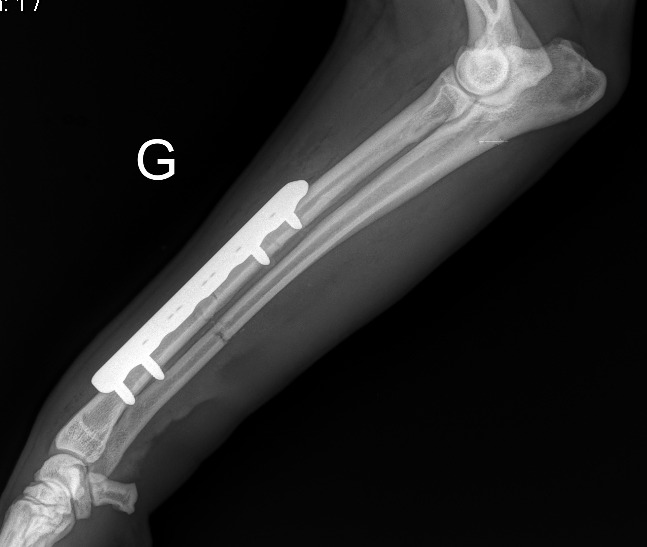
a plate fixed to the bone with screws;
screws alone to compress certain fragments;
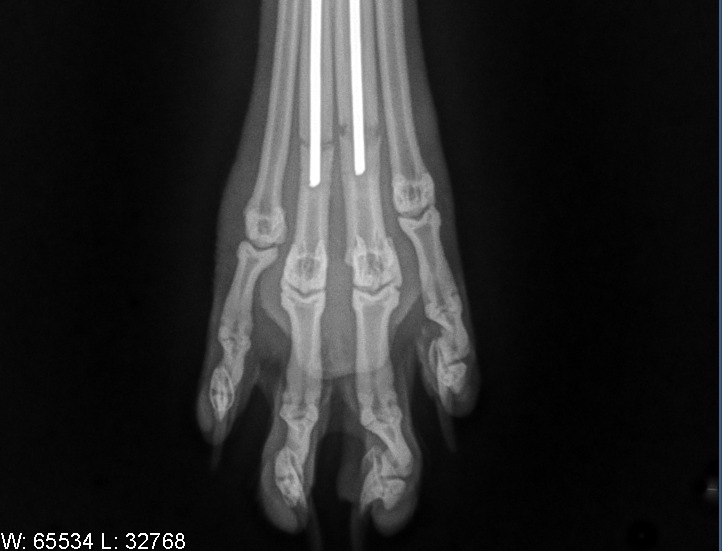
one or more pins placed within the bone;
metal cerclage wires combined with other implants;
an interlocking nail placed in the medullary canal;
an external fixator connected to the bone by pins passing through the skin.
The choice of construct depends on the bone involved, the shape of the fracture, the number of fragments, the age and weight of the animal, and the forces acting on the limb. We describe these techniques in our article on fracture surgery and recovery.
Implants do not replace bone. They protect it while it heals. Until healing is sufficient, they remain subject to repeated stress with every step, jump or slip.
Can a plate or screws stay in for life?
Yes. When a fracture has healed properly and the hardware causes no pain, infection or irritation, it can usually be left in place.
Removing every implant as a matter of routine would needlessly expose the animal to another anaesthetic and a second procedure. Removal can also be more delicate once tissues have organised around the plate, or when bone has partly covered some of the screws.
The decision still depends on the type of implant and its location. A plate lying deep under muscle does not have the same consequences as a pin sitting just beneath the skin. Some constructs are designed to be removed after healing, in particular external fixators. For the others, the decision is made case by case.
A fracture stabilised with pins : the position and depth of the hardware influence whether it should be removed.
When should removal be considered?
Five situations most often lead to discussing removal :
an infection around the implants;
tissue irritation from a plate or a pin;
a pin or screw that moves;
a bent or broken implant;
an animal that is still growing.
Each of them is covered in detail in the sections that follow.
An infection around the implants
An infection can appear in the days following surgery, but it can also show up much later. The presence of an implant can help bacteria persist, particularly when they attach to its surface and organise into a biofilm.
Possible signs include :
persistent swelling or heat around the surgical site;
pain or lameness that comes back;
discharge from the scar;
a wound that reopens or fails to heal;
more rarely, a fever or a decline in general condition.
When the fracture has not yet healed, removing all the hardware immediately can leave the bone unstable. Management must then balance controlling the infection with maintaining adequate fixation. Revising the construct is sometimes necessary.
When the bone has healed solidly, removing infected hardware can make the infection easier to treat. Bacteriological samples are usually taken during surgery to identify the bacteria involved and adapt the antibiotic treatment.
Tissue irritation
Some anatomical areas have little muscle or fat covering them. A plate or the end of a pin can then irritate the skin, a tendon or the surrounding tissues.
This irritation can cause localised pain, discomfort with certain movements, persistent lameness or repeated licking. It should not, however, be concluded simply from feeling a plate under the skin : in a lean animal, being able to feel the hardware can be perfectly normal.
An orthopaedic examination and X-rays make it possible to determine whether the implants really are responsible for the signs.
A pin or screw that moves
A pin can sometimes migrate and become prominent under the skin. A screw can also loosen if healing is insufficient or if the construct is subjected to excessive loads.
Migration, loosening or any change in the position of the hardware warrants a prompt check. Depending on the stability of the fracture, the implant concerned may be removed, replaced or combined with new fixation.
You should never try to push back or remove a protruding pin yourself.
A bent or broken implant
A plate that bends or breaks before healing generally indicates that the construct was subjected to more stress than it could withstand, or that the bone did not heal as expected. This is a significant complication requiring prompt radiographic reassessment.
Revision surgery is often needed if the fracture remains unstable. Conversely, finding a small broken implant fragment late on does not always mean everything must be removed, provided the bone has healed perfectly and the animal has no symptoms. The expected benefit has to be weighed against the difficulty and risks of extraction.
An animal that is still growing
In a puppy or a kitten, bone growth must be taken into account from the moment surgery is planned. An implant close to a growth plate, or one that could restrict the development of the bone, may require particular monitoring and, in some situations, planned removal.
This does not mean that every implant has to be removed in young animals. The decision depends on the age, the location of the fracture, the type of construct and the remaining growth.
Why shouldn't implants be removed too early?
An animal can start walking comfortably well before the bone has regained sufficient strength. The absence of lameness is therefore no proof that the fracture has fully healed.
After a plate is removed, the holes left by the screws are temporarily areas of reduced strength. The bone must gradually remodel before it can withstand heavy loads again. Removal that is too early, or a return to activity that is too quick, can therefore favour a new fracture.
This risk deserves particular attention for radius and ulna fractures in small-breed dogs, in which the quality of the bone under the plate can sometimes be reduced.
There is no universal timeframe that applies to every animal. The time needed varies with the bone involved, the configuration of the fracture, the patient's age, the construct used and the progress seen on X-rays.
How do we know the bone has healed enough?
The decision must not rest on time since surgery alone. It combines :
the clinical examination and assessment of weight-bearing;
palpation of the surgical site;
checking for pain, swelling or abnormal movement;
X-rays taken in at least two directions;
comparison with previous images.
X-rays make it possible to assess the gradual disappearance of the fracture line, the formation or remodelling of the bone callus, the continuity of the cortices and the stability of the implants.
In some complex fractures, X-rays may not be enough to confirm healing around the whole circumference of the bone. A CT scan may then be suggested before deciding on removal.
What does removing a plate, screws or pins involve?
Removal is performed under general anaesthesia and in sterile surgical conditions. The surgeon generally reuses the original approach in order to reach the hardware while limiting damage to the surrounding tissues.
Depending on the implants and how long they have been in place, the procedure can be straightforward or more technical. A screw may be covered by bone, have a damaged head recess, or be difficult to separate from the plate. If there is an infection, abnormal tissue is removed and samples are taken before antibiotic treatment is given or adjusted.
A postoperative X-ray may be taken to check that the intended hardware has indeed been removed and to assess the appearance of the bone. These procedures are carried out in our surgical suite, equipped for orthopaedics.
What is recovery like after implant removal?
Even when the original fracture has healed, removing the hardware should not be seen as a procedure without convalescence.
During the first few weeks, it is generally necessary to :
limit the dog to short walks on the lead;
avoid running, playing, stairs and jumping;
keep the cat in a confined space;
protect the wound from licking;
give the prescribed medication;
attend the wound check and any follow-up X-rays.
How long these restrictions last depends on the bone involved, the amount of hardware removed and the quality of the bone seen during surgery.
Which signs should prompt a check-up after fracture surgery?
A check-up is recommended in case of :
lameness that returns or worsens;
new pain in the operated limb;
swelling, heat or redness;
discharge from the old scar;
persistent licking;
a palpable implant that has suddenly become more prominent;
a significant knock to the operated limb.
These signs do not necessarily mean the hardware has to be removed. They do justify an examination to look for infection, irritation, implant movement or a healing problem.
How we handle this at Colvet
At Colvet, the decision to keep or remove an implant is based on the orthopaedic examination, the clinical progress and the interpretation of follow-up X-rays. The aim is not to remove hardware as a matter of routine, but to intervene when leaving it in place carries more drawbacks than taking it out.
If the fracture surgery was performed elsewhere, previous X-rays and, where available, the surgical report allow us to identify the type of implant and to compare how healing has progressed.
A plate, screws or pins should therefore not be removed simply because a certain amount of time has passed. Every decision has to be tailored to the fracture, the construct and the animal.
Scientific sources
This article draws on the following veterinary publications:
Sandness BM, Perry KL, Bruce M. Single institution retrospective study evaluating the frequency of implant removal and associated risk factors following open fracture fixation in 80 cases (2010–2020). BMC Veterinary Research. 2023;19:119. doi.org/10.1186/s12917-023-03687-0
Menghini TL, Shriwise G, Muir P. Fracture Healing in 37 Dogs and Cats with Implant Failure after Surgery (2013–2018). Animals. 2023;13(9):1549. doi.org/10.3390/ani13091549
Muroi N, Kanno N, Harada Y, Hara Y. A Retrospective Study of Risk Factors Associated with Refracture after Repair of Radial-Ulnar Fractures in Small-Breed Dogs. Veterinary and Comparative Orthopaedics and Traumatology. 2025;38(2):77–86. doi.org/10.1055/s-0044-1790218
Serratore VR et al. Results and complications after removal of tibial tuberosity advancement cage and plate in dogs. Veterinary and Comparative Orthopaedics and Traumatology. 2018. PMID 30094847
Arthur EG, Arthur GL, Keeler MR, Bryan JN. Risk of Osteosarcoma in Dogs After Open Fracture Fixation. Veterinary Surgery. 2016;45(1):30–35. doi.org/10.1111/vsu.12416
General information article. It does not replace a consultation: only a veterinary examination can establish a diagnosis and offer the treatment suited to your animal.
Has your animal had fracture surgery?
Any doubt about a plate, a screw or a pin deserves a follow-up X-ray
We also see animals operated on elsewhere, together with their previous X-rays.