Cruciate ligament rupture : what are the symptoms ?
A cruciate ligament rupture doesn't always cause a dramatic limp. In some dogs it settles in gradually, fades under anti-inflammatories, then comes straight back once treatment stops. Here are the signs to watch for.
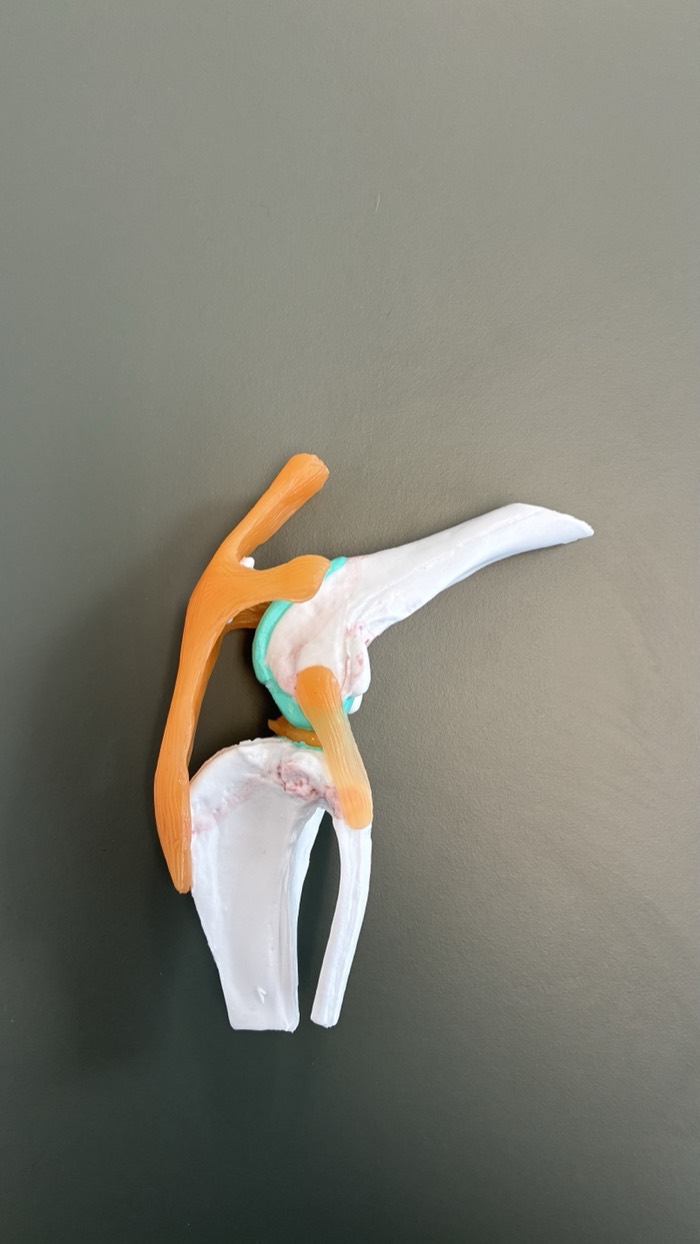
Anatomical model of a dog's stifle : femur, ligaments and tibia.
Cruciate ligament rupture
How to recognise a cruciate ligament rupture in dogs
A cruciate ligament rupture doesn't always cause a dramatic limp. In some dogs it appears suddenly. In others, the limp settles in gradually, fades for a few days on anti-inflammatories, then comes straight back once treatment stops.
This deceptive pattern explains why some ruptures, especially partial ones, can go unnoticed for weeks or even months.
What does the cruciate ligament do ?
The cranial cruciate ligament sits inside the dog's stifle (knee). It helps keep the tibia in a stable position relative to the femur.
When it's partially or fully torn, the joint becomes unstable. With every step, the tibia tends to slide abnormally forward under the femur. This instability causes pain, joint inflammation and, over time, osteoarthritis.
Contrary to what many owners assume, the rupture doesn't always follow an accident. In many dogs the ligament weakens progressively before finally tearing during an otherwise ordinary movement.
What are the early signs to watch for ?
The most common sign is limping on a back leg. Its severity can vary considerably.
Your dog may :
touch the ground with only the tip of the toes ;
refuse to bear weight on the leg at all ;
limp more after a walk or a play session ;
seem stiff when getting up after resting ;
hesitate before climbing stairs ;
refuse to jump into the car or onto the sofa ;
sit with a back leg held slightly out to the side ;
shift more weight onto the front legs ;
gradually lose muscle mass in the thigh.
Swelling can also appear around the knee. In chronic cases, the inside of the joint may feel thicker due to inflammation and progressive osteoarthritis.
Can both knees be affected ?
Yes. Cruciate disease is often linked to a gradual weakening of the ligaments rather than a single traumatic event.
A dog presented for a rupture on one side may already show subtle signs of inflammation or instability in the other knee. Some dogs go on to rupture the second ligament months or even years after the first.
That's why both hind limbs should be examined, even when the limp appears clearly one-sided.
How does the vet reach a diagnosis ?
Diagnosis starts with a full orthopaedic examination. Observing that the dog limps isn't enough : we need to pinpoint exactly which joint is painful and rule out other causes.
The vet assesses gait, weight distribution, the muscle mass of both thighs, pain on manipulating the knee, any swelling, and the stability of the stifle.
Two manoeuvres matter in particular : the cranial drawer test and the tibial compression test. Both look for abnormal forward movement of the tibia relative to the femur. In a dog that is painful, anxious or very muscular, light sedation may be needed to relax the muscles and examine the knee properly.
Does improvement on anti-inflammatories rule out a rupture ?
No. Anti-inflammatories can reduce pain and inflammation for a few days. The dog then starts using the leg better, but the medication doesn't repair the ligament or resolve the instability in the joint.
The limp therefore commonly returns once treatment stops, or after more intense activity. A limp that :
improves on anti-inflammatories ;
comes back once they're stopped ;
recurs several times on the same back leg ;
should prompt a search for a mechanical cause, in particular a cruciate ligament problem.
Why are partial tears harder to recognise ?
When the ligament is completely torn, joint instability is usually significant and the limp can be pronounced.
In a partial tear, some of the ligament's fibres remain intact. The dog may continue to walk fairly normally and only limp after exercise. Instability can be subtle, particularly when the animal tenses its muscles during the exam.
Partial tears tend to progress. The remaining fibres can keep deteriorating until the ligament fails completely. Chronic pain and instability also encourage osteoarthritis and can be associated with a meniscal injury.
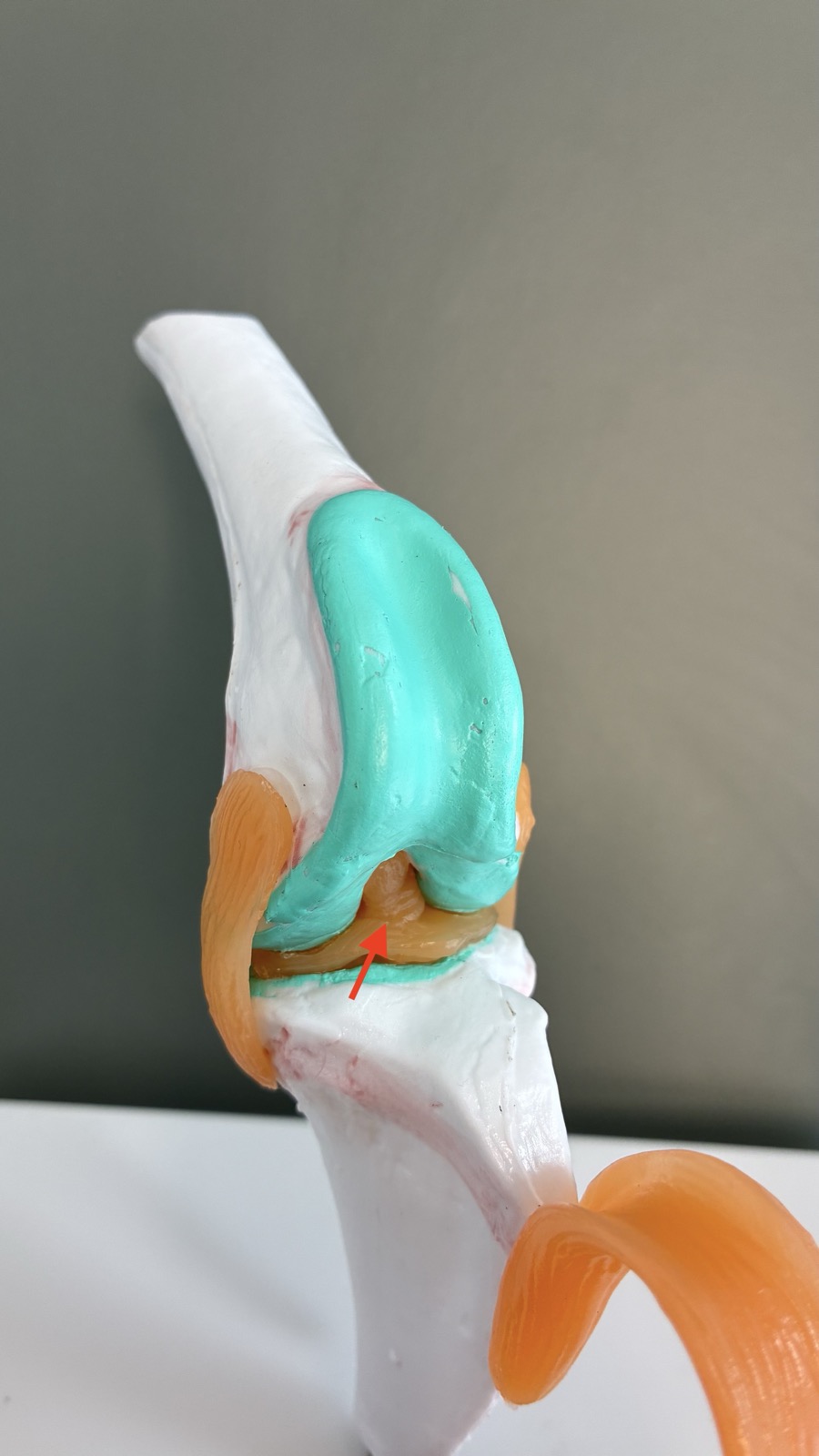
The cranial cruciate ligament, highlighted.
What is the role of X-rays ?
The cruciate ligament itself is usually not visible on a standard X-ray. Radiographs remain essential though, to look for joint effusion, signs of inflammation, early or advancing osteoarthritis, an abnormal tibial position, or another bone condition that could explain the limp. We cover these signs in detail in the signs on examination and on X-rays.
They're also used to measure tibial anatomy when TPLO surgery is being considered. Diagnosis always rests on combining the dog's history, the orthopaedic exam and the radiographic images.
When should you see a vet ?
A consultation is recommended when a hind-leg limp persists for more than a few days, comes back regularly, reappears once anti-inflammatories are stopped, worsens after exercise, stops the dog climbing stairs or jumping, comes with muscle loss, or leads to complete non-weight-bearing.
It's best to avoid repeated cycles of waiting and symptomatic treatment without a clear diagnosis. In the meantime, instability can keep damaging the joint and speed up the progression of osteoarthritis. Never give a dog an anti-inflammatory intended for human use without veterinary guidance.
What does the exam look like at COLVET ?
During a consultation for limping, we start by watching the dog move. We then examine the whole limb to pinpoint exactly where the pain is coming from.
When the knee is suspect, we systematically compare both sides and look for instability consistent with a cruciate ligament problem. X-rays are always taken before discussing surgery, to confirm joint changes, rule out other conditions, and determine the most appropriate treatment.
The goal is to reach an accurate diagnosis before deciding on treatment, rather than temporarily masking the pain without identifying its cause.
General information article. It does not replace a consultation : only a veterinary examination can establish a diagnosis and recommend the treatment suited to your pet.
Limp that keeps coming back ?
Get your dog's knee checked for stability
Is your dog limping on a back leg, or does the limp return every time you stop anti-inflammatories ? An orthopaedic consultation can check whether the knee is stable and look for a possible cruciate ligament rupture.